
In that talk, he uses a program that makes animations of data in beautiful and intuitive ways and that yield real insight. Since he made that video, he has started a website where that program is available for use directly on the website using Adobe Flash. The site is http://www.gapminder.org/ and it really is a wonder. My son, in the 6th grade, couldn’t stop playing with it, and was immediately drawn in to the questions the graphs you create present. Why was there a “Bangladesh Miracle”? Why does China’s life expectancy suddenly drop 20 years around 1960, and then quickly rise again? Why did the average number of children per women in the U.S. rise sharply between 1940 and 1970? Why is the connection between average income and mortality so varied in different parts of the world?
I never was that interested in statistics and data analysis when I was in school. With this program, it takes a herculean effort NOT to be interested.
There are times when you can tell your class is a little fried and they need some short-term gratification rather than the usual drawn-out discussions. Last period Friday, in particular, is a time when it is useful to have some math games ready to go. So on this Friday I’ll describe a game that I stole from the wonderful Public Television show Square One. (Remember that?)
As the “host”, I set up the digits of an arithmetic problem like _ _ _ + _ _. (Actually, I make each digit a box rather than a dash, but that’s much easier to do on a whiteboard.) Students copy this into their notebooks. Then I use a calculator to randomly generate digits ranging from 0-9, repeats allowed. As I read each digit, students place the number in one of the boxes, with the goal of making the largest sum possible. The catch is that they are not allowed to move a digit once they place it. The winner, at the end, is the student with the largest sum. (You could also ask for the smallest sum, of course.)
Of course, this game is too easy for high school. The strategy is clear to the students, and after that it’s all luck. So after we play with the initial setup, to get the idea of the game, I begin to vary the game board, tailoring it to the level of the class. _^_ + _ _ _ _ is an interesting one – is it best to use a nine, if it is chosen, as the base of the exponent, the exponent itself, or the first digit of the four-digit number? Using fractions reinforces the concept that the bigger the denominator, the smaller the value of the fraction. You can also involve “sin(_ _)” in your expression (specifying that you are using degrees), and students will need to think about what degree value will maximize the sine function. For students thinking about limits, you can compare ratios of different types of functions so that students need to think about the shapes of their graphs and their end behavior.
I like this game for several reasons. First of all, there’s an element of suspense when choosing the final few digits that always puts students on the edge of their seats. Almost all students like this game and find it engaging. Secondly, when the game is over (and they are allowed to talk about it), students want to argue about what the best possible result would be. Because of this, they make all the mathematical arguments appropriate to the game board without my having to prompt them. Third, it is extremely malleable to the needs of the class, and it can be anywhere from very easy to very hard.
One final note: I’ve been able to find only one web clip of this game, here. They play a simple version in which the object is to make the largest five-digit number possible. Watching it (if you can make it past the super-silly intro) might give you an idea of the principle of the game.
[This post also appears as a guest post over at Sam Shah’s blog.]
This is a post about a problem that never fails. It’s the problem I used for my sample lesson when interviewing for jobs four years ago. It’s the one I almost always use on the first day of class, and it’s also what I give to parents on back to school night. Because… well…it. never. fails. Seriously.
The perfect, ineffable jewel of a problem to which I refer is the classic Bridges of Konigsberg problem. Here’s the story, in case you don’t know it:
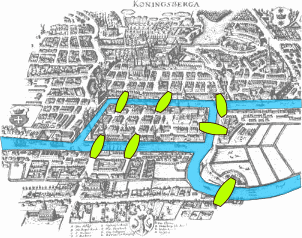
As shown in the image above, the town of Konigsberg once had seven bridges. Back before some of these bridges were bombed during WWII, the residents of the town had a long-standing challenge: to walk through the town in such a way that you crossed each bridge exactly once—i.e., without missing any bridges, and without crossing any of them twice.
So, why is this problem so great for a high school classroom? Well, first of all, whenever I tell this rather contrived tale to my students (or their parents, for that matter), they are inevitably scribbling on their scrap paper before I can even finish. It’s a compelling puzzle, simple as that.
Before long, students have redrawn the thing enough times that they’re annoyed with all the extra time it takes to draw all the landmasses and bridges, and so they simplify it:

Voila: in a completely natural fashion, they have reduced the problem just like Euler did. At this point, I usually bring them together for a moment to appreciate what’s going on here: reducing a problem to its essential components, finding the simplest way to represent the underlying structure of the situation. (And I also mention to them that this is precisely the move that Euler made when he invented graph theory based on this initial problem.) Even if they never went any further, this is already a nice lesson in problem solving.
[SPOILER ALERT: notes on the solution below the fold]
Yesterday I opened class with this question, taken from the University of Maryland High School Mathematics Competition (2005):
What is the value of log (2/1) + log(3/2) + log(4/3) + … + log(99/98) + log (100/99) ?
Students who remembered their logarithm properties (from the last time we had class…) saw almost immediately that they could multiply the arguments together and, ta-da, have the numerator cancel with the denominator until it becomes just log (100) = 2. But there were a few groups who didn’t remember this property. Well, one group knew they could expand the arguments into log 2 – log 1 + log 3 – log 2… but didn’t follow this logic far enough to solve the problem. That would’ve been cool, and it’s exactly why I ask students to share ideas that didn’t work– sometimes it’s a bad idea, other times it’s bad execution.
But anyway, I write because one group was kind of sitting and starting at the problem. I heard one of them say, “You know the first one is going to be the biggest, and the others get smaller… and they are getting closer to 0.” And I thought: cool! They just turned this log properties problem into a sequences problem, even looking at what the terms are approaching! I missed this structure of the terms because I had so quickly calculated the answer. I had acted exactly like the students Mimi was talking about in her post (A critical mass problem)– I missed subtlety in my haste to get the answer. It was a little unfortunate that this group couldn’t actually solve the problem with their realization. It’s always fun when a cool insight actually helps you to solve the problem. Maybe next time.
Yes, this is math class, but especially in a problems-based curriculum we are teaching reading at the same time, right?
I recently gave two classes the following problem*: “How many triangles are there whose three vertices are points on this 3×3 square grid?”
Once they put their heads together, kids are able to make nice progress on this problem. It’s intended to teach the habit of “taking things apart” (most kids tend to say, “break it down”), and comes with a suggestion to count the number of triangles you can make within a 2×2 grid, then a 3×2 grid, then the full 3×3 grid. Not all kids take this suggestion (and good for them), but most wind up categorizing triangles by type somehow and then counting how many there are of each type of triangle.
Looking back, I think about the little things that tripped up the kids, all of which had to do with implicit assumptions about what the problem was asking. Some kids wanted to know if the vertices of the triangles had to be on the dots in the grid, or if they could be in between. Other kids assumed that the triangles had to be right triangles, or else asked if it was okay to use non-right triangles; these kids thought that there was real ambiguity in the question. I want too much to be helpful, and for the students to be able to get on with their math, so in this case I answered their questions directly rather than doing what (I suppose) I should do: telling them to read the question again. At times I have done a better job guiding students back toward the question. I resolve to be so good again!
Other questions that the kids had about the wording of the problem struck me as more legitimate. One question that came up was, “if two triangles are the same shape, should we count them as different triangles?” Here I think the kids have a case that the question is ambiguous. After all, we are just beginning to study graph theory, in which we’re about to call several pairs of isomorphic graphs that look nothing alike “the same.” I’ve encountered many problems over the course of teaching that, while not ambiguous to someone “in the know,” can actually be read a few different ways by an attentive student. I suppose that teaching students the conventions of mathematical language is also “teaching them to read.”
*this problem appears in our textbook, inspired by a problem on a Math Counts competition.
I have always found assessment in the math classroom really quite difficult. There are so many issues, but the biggest ones I can think of are the problems of mastery and depth. Traditional math tests, like the ones that I give about every 3 weeks, and have done for 22 years, are basically a test of mastery. Some of my colleagues strenuously object to this goal, or at least this framing of what a test is for, but in my opinion that is what a test basically is for. Other teachers in the department would say that by giving a student another chance to solve a similar, analogous problem (sort of retesting on a problem-by-problem basis), or by showing extensive corrections, or by creating their own analogous problem along with an answer key, we allow them the space to revise their understanding and show them that instantaneous mastery is not being demanded of them.
But note the structure that all of us have accepted in the first place: tests. My colleagues who disagree with me give them as well, they just don’t want them to feel as punitive or “final” as they did when they were students in school. They want them to be more of a teaching tool. And I am sympathetic to that goal, I really am.
But I don’t do that in my classroom. Basically, I give a test to my kids about every 3-4 weeks. I give them past tests with answers and/or review problems with answers to study from ahead of time so that they have some idea of what will be expected of them on the test, in terms of content, difficulty, and structure. They know that the test may look very different, or quite similar, to the kinds of problems I have given them for review, but that if they can’t at least do the review problems, they will likely have a hard time on the test.
So why do I do it this way, which evokes memories of damp English boarding schools? Competence in mathematics means, to all the math teachers that I know, the ability to solve problems in mathematics, and not only ones that are similar to those you have seen before, but also those that are unfamiliar. To be able to do that well, you need a good deal of exposure to a range of problems on the material before someone checks to see if you really are able to solve problems on a given topic. Homework is one way to do that, and our text , being in my opinion much less rote than many traditional texts, has definitely helped in that matter. But students need more practice, in more contexts, before being tested—thus the review problems and my instructions to make sure to complete a healthy number of them before a test. What a test positively offers is a chance to know that you know; one good thing about mathematics having answers that are so specific is that a student can see if their chain of reasoning is correct at a glance, because the answer to that review problem was indeed 113.67 and not something else.
And also for most kids, in my experience, when I did offer revision, they became much less focused before the test, and didn’t complete the review problems as thoroughly, because they knew they could “revise” later. I don’t blame them—it is human nature. Now I offer test revisions in unpredictable fits and starts, so that students take tests seriously the first time.
Which is not to say that I am completely happy with tests, not at all. But they are very effective at helping a student to know what they know, and to know what they do not know. They also are clear and are perceived by students as being fair; one thing I always tell them is that when grading tests I look to see if there is any question that basically all the students missed, because then I am likely to throw that one out as it clearly was not a fair expectation that they could get it. So students like the finitude of tests, and they like that have a good sense of what will be on them. And to be clear, I ask a wider range of questions on tests than I used to with previous texts, because the problems in our texts have greater range and diversity, so students naturally expect that the questions they have to answer are quite varied.
But, ironically, the reason I’m writing this entry is because I have been thinking about the limitations of tests as assessment. What else do I want out of assessment? Well, I want to see if students can ASK questions about extending and generalizing a problem, as well as answering them. I want to see if students can use mathematical habits of mind more systematically and consciously when confronted with a difficult problem. I want to see how a student handles an open-ended question, rather than one that has a specific algebraic or numerical answer. I would like students to be able to lead a discussion of a problem, much like they do in an English class or a History class. I would like students to feel, for certain limited topics, that they have gone in more depth than their peers and have attained a real mastery of something.
Currently, the best my tests do is see if my students can handle a range of types of questions about the material at hand, maybe with a little bit of using mathematical habits of mind to make progress on the more unusual problems. I’m not really addressing much else of what I listed in the last paragraph with tests.
So how am I going to do that? This blog entry is already too long, so I’ll try to begin to answer that next time, or the time after if the start of school brings up a topic or two that merits an immediate response.
One of the things I like best about the way we teach math at Park is that the problems themselves serve as intrinsic motivation. Sure, not every kid is perfect about doing their homework or working as hard possible, but we’re far away from the situation where it’s the impending test that motivates a kid to do their work. Most kids are interested in the conversation that happens in class and almost can’t help but give thought to the problems before them.
Every now and then I have a class that thinks that the material is too easy, despite my feeling that most students in the class are not giving the material the thought it deserves, and sometimes even despite the fact that I know there are basic skills that most students have not mastered yet. This could happen in a geometry class, where it’s easy to trick yourself into thinking that an informal argument appealing to symmetry, say, is sufficient, when actually a proof is needed. Or, if the topic is algebra, a “which of the two quantities is bigger” question: to which savvy students often know that the answer is almost always, “they’re the same size,” even if they can’t provide the algebraic justification.
Often, it’s very smart students who have this view – they’re able to intuit their way to an answer for some problems without needing to go through the thought process that the person who wrote the problem intended. It’s great if they can do that, of course, but they may be missing a chance to generalize their method to future problems. That is, they may be missing the core content of the class. Even more importantly, in their eagerness to get the problem done, they’re robbing themselves of the opportunity to be a mathematician. If a problem seemed dumb… what do you suppose you were supposed to get out of the problem? What is its larger significance?
In these situations, if I give a test that I feel is reasonable given my expectations of the students, they don’t do very well.
Because we only give tests once a month or so, it takes too long to give students the feedback that they don’t understand everything they think they understand. Part of me has the impulse, then, to give them quizzes to hammer home the point. But this is not really what I want to do. For one thing, I don’t want students in my classes to feel that they constantly have to be completely on top of the skills and content in the course. Too often, we are in discovery mode, where we are debating the appropriateness of the very skills I’d be quizzing on. It takes time for the dust to settle. And perhaps more importantly… is a test or a quiz the only way to give feedback to a student about how they’re doing? Shouldn’t there be a way to give that feedback more naturally? In most of my classes, when the majority of the students understand the spirit of the class and the exploration, students will let each other know if their arguments are too vague. In the type of class I’m describing, where there isn’t this critical mass, it’s harder.
The way I have dealt with this issue in the past is to collect homework more often, either for a small grade or just for written feedback. Still, I’d like a way to send a message to these students that even the easiest problem contains a world of follow-up questions, generalizations, and connections to other topics. A message other than “teacher says,” of course.
Just doodled these “Oroborromean rings”…

… which I learned how to do from the video below. The video is one of the loveliest things I’ve seen in a while… both for the doodles themselves, as well as for mathematically playful, yet also slightly snarky commentary.
One of my favorite moments in the classroom is when students are thinking about some really interesting problem… perhaps they’ve even posed an extension of a problem in their textbook… and they are excitedly discussing it. They build on one another’s ideas, they inevitably argue, there is a back-and-forth that continues until they’ve really gotten somewhere. Occasionally I will step in to resolve a dispute or get the students to think more carefully about some misconception they’ve been running with, but for the most part it is the material itself that drives the discussion.
There is a tension, though, between letting the discussion flow naturally and between creating a balance of voices heard in the classroom. When things get exciting, it is much harder, and perhaps not even the right thing, to let the students speak in turn. Because there is often one person who has had the crucial idea, the other students’ comments tend to be directed at that person, who may then be speaking every other comment. Because the discussion is heated and the people who’ve just spoken want to respond right away, there is also less “space” in the discussion for people who are not as in the thick of it to jump in. I worry in these cases about quieter students, students who take a bit longer than others to formulate their ideas, more tentative students, and students who’ve simply missed some of the framing of the discussion and aren’t quite sure what we’re talking about.
Here are two strategies I’ve sometimes used to make these conversations more friendly to every student. 1) Go to a strict hand-raising system, in which the two or three most ardent students have to wait to bring their ideas forward while we hear from other people who have more tentative and perhaps less-formed opinions. 2) Go to group work for five minutes and let each group the chance to discuss the material, then report back, at which point multiple groups might have definitively solved the problem, or, if not, at least we can begin the discussion again with more students “on the same page.”
While I do sometimes use those strategies, #1 especially feels strange, as if I’m killing the momentum of the discussion. At a private school we have the luxury of small classes, but there is still something that seems artificial about having a discussion with more than, say, three people at once. What does it look like to have an open-ended discussion in which most students are involved, that at the same time builds on an idea and approaches a conclusion?
 acohen77
 acohenher
 Anand
Anand Angela
 btabrisky
 Mimi
Mimi Tony
Tony Park School Math